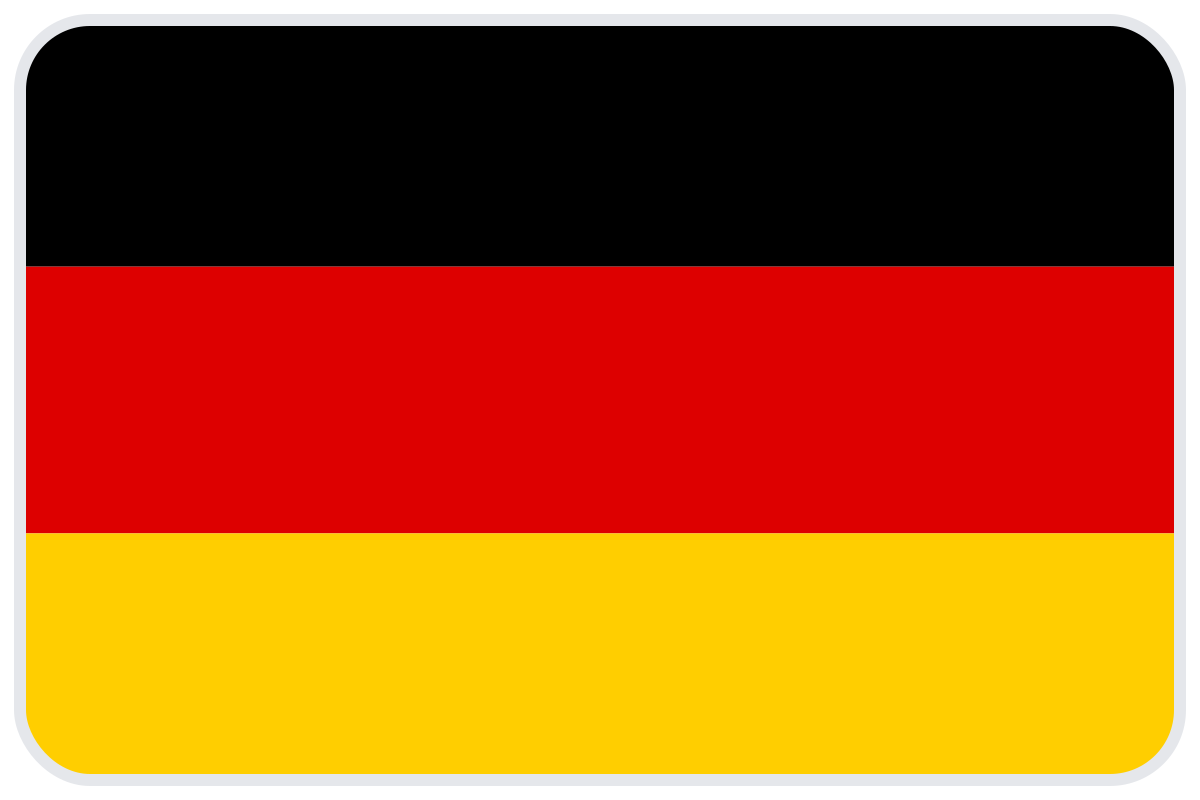
| Manager | Julian Nagelsmann |
| Founded | 1900 (age 126) |
| FIFA Ranking | 12th Place |
| UEFA Ranking | 10th Place |
| Best Finish | Champion (1954, 1974, 1990, 2014) |
| Group 2026 | E |
Germany World Cup 2026 winners: Can the Mannschaft return to greatness?
Germany arrives at the 2026 World Cup with a clear mission: to rediscover the competitive edge that has made them one of the most successful national teams in history. After two consecutive group stage eliminations in 2018 and 2022, the Mannschaft wants to prove that its transition period can finally transform into a credible new project.
The 2026 World Cup will be played in Canada, Mexico, and the United States, featuring 48 teams and 104 matches. FIFA indicates the tournament will begin on June 11, 2026, and the final will be on July 19, 2026. UEFA also confirms that Germany qualified as winners of European Group A and has won four World Cups: 1954, 1974, 1990, and 2014.
In this context, the odds for Germany to win the 2026 World Cup can help gauge perception around the team, but they don't tell the whole story. The odds for Germany to win the 2026 World Cup must be evaluated alongside defensive stability, leader form, midfield performance, and their path in the knockout stages.
Some users also observe crypto-betting platforms like Dexsport to follow trends related to international football. This type of analysis remains informative and does not replace sports analysis.
Germany's Group E
Germany is in Group E with Curaçao, Ivory Coast, and Ecuador. The group is interesting because it presents three different challenges: an emerging national team without much World Cup experience, a physical and intense African team, and a South American selection accustomed to competitive rhythms.
Opponent | Profile | What Germany needs to control |
Curaçao | Enthusiasm, mental freedom, first experience | Avoid underestimation and start strong |
Ivory Coast | Physicality, duels, transitions | Manage intensity and second balls |
Ecuador | Pressing, rhythm, organization | Stay compact and maintain control |
The betting odds for Germany to win Group E and the 2026 World Cup will be closely watched, especially in the initial phase. On paper, the Mannschaft starts with significant ambitions, but the group should not be treated as a formality. A first-place finish can help build confidence and improve their possible subsequent path.
Why Germany remains a tournament team
Even in difficult times, Germany maintains a rare characteristic: a strong competitive culture. Its World Cup history is significant, as is its ability to build disciplined, physical, and mentally prepared teams.
European qualification was not entirely straightforward. According to UEFA, Julian Nagelsmann's team started with a defeat against Slovakia, but then concluded their journey with a clear 6-0 victory in the decisive return match. This detail perfectly illustrates Germany's current moment: not a team without doubts, but a group that can react.
The first strength is the midfield. Germany can count on players capable of controlling the rhythm, pressing, playing vertically, and connecting departments. In a long World Cup, quality in the central area will be decisive.
The second point is tactical tradition. The Mannschaft can adapt, change structure, and face very different opponents. This flexibility will be useful in Group E and, especially, in the final stages.
The Mannschaft's strengths
Germany should not be judged solely by recent disappointments. Its potential remains significant, especially if the group finds consistency in the early matches.
Strength | Possible impact in 2026 |
Tournament culture | Managing decisive moments |
Midfield quality | Controlling rhythm and pressing |
Physicality | Duels, set pieces, intensity |
Tactical flexibility | Adapting to different opponents |
Motivation | Reaction after recent disappointments |
The midfield can become the heart of the project. If Germany can control the game without exposing themselves, they can better support the attackers and protect the defense. Set pieces can also become a weapon, especially against teams that defend deep.
The odds for Germany to win the 2026 World Cup can therefore reflect a delicate balance: on one hand, historical prestige, and on the other, the need to demonstrate on the field that the team has rediscovered consistency.
Risks not to ignore
The first unknown concerns defensive stability. In recent major competitions, Germany has often suffered from individual errors, spaces conceded in transition, and moments of disorganization. In 2026, they cannot afford these lapses.
The second concerns offensive effectiveness. Producing play is not enough: dominance must be converted into goals. If the Mannschaft creates chances but doesn't close out matches, they risk coming under pressure and losing control.
The third question is mental. After two disappointing World Cups, the group will have to prove they can live with the past without being paralyzed by it. A positive start can free the team; an uncertain start can reopen doubts.
For this reason, the odds for Germany to win the 2026 World Cup must be read with caution. Germany's name carries weight, but the tournament will reward the most solid team in the present, not the most prestigious on paper.
Brazil and Spain: two useful comparisons
To understand the level required of Germany, it is useful to compare them with other major contenders. Brazil remains one of the most talented and unpredictable national teams in the tournament. Their ability to create out of nothing can trouble any defensive structure. You can delve deeper into their profile on the page about Brazil winning the World Cup.
Spain, on the other hand, represents a very interesting tactical comparison. La Roja can control the ball, press high, and force opponents to defend for long periods. For Germany, facing such a team would mean testing their maturity in possession and in the non-possession phase. A dedicated analysis is available on the page about Spain winning the World Cup.
France, Argentina, England, and Portugal also remain top-tier opponents. To win the tournament, Germany will likely have to overcome at least one or two national teams of this caliber.
How to read odds and trends for Germany
The betting odds for Germany to win Group E and the 2026 World Cup can change quickly even after the first matches of Group E. A convincing victory can boost confidence; a complicated draw or a nervous performance can reopen discussions.
To seriously evaluate the Mannschaft, it is advisable to follow:
- defensive line solidity;
- goalkeeper performance;
- pressing quality;
- effectiveness in the final third;
- set piece management;
- leaders' condition;
- bench depth.
Users observing crypto trends around football can also consult the FIFA World Cup page on Dexsport. On platforms like Dexsport, this data should remain informational support, not a guarantee of results.
Possible scenarios for Germany
The ideal scenario is a solid start in Group E: controlled victory, stable defense, and dominant midfield. In that case, Germany could build confidence and arrive at the knockout stages with a different feeling compared to recent World Cups.
A more complicated scenario would be a team that dominates without scoring or concedes too many transitions. In this case, even a theoretically manageable group can become dangerous.
The key will be balance. Germany will have to reclaim its historical identity — discipline, pragmatism, mental strength — without sacrificing modern play. If they can combine pressing, control, and pragmatism, they can once again become a very difficult team to eliminate.
Conclusion
Germany may not necessarily start as the brightest team in the tournament, but they remain a national team to respect. Their history, qualification as group winners, midfield talent, and desire for redemption make them an interesting candidate.
To truly aim for the title, however, clear answers will be needed: more stable defense, greater offensive effectiveness, mental management, and consistency. Group E will immediately offer a useful test to see if the Mannschaft has become reliable again.
If Germany regains compactness and clarity in key moments, they can turn 2026 into a comeback tournament.
FAQ
Can Germany win the 2026 World Cup?
Yes, Germany can aim for a significant run if they regain defensive stability, offensive effectiveness, and consistency in decisive matches.
Which group is Germany in for the 2026 World Cup?
Germany is in Group E with Curaçao, Ivory Coast, and Ecuador. The group seems manageable but requires concentration from the first match.
What is Germany's main strength?
The main strength is their tournament culture, combined with midfield quality and tactical adaptability.
What is the main risk for the Mannschaft?
The main risk is a lack of stability. If Germany concedes too many transitions or fails to close out matches, their path can become complicated.
Are Brazil and Spain direct rivals of Germany?
Yes. Brazil and Spain represent two very different tests: offensive talent and unpredictability for Brazil, control and pressing for Spain.